EN
EN

- Overview
- Recommended Products
- Demonstration of installation procedures of split-type air conditioners
- Study of refrigeration cycle and system components
- Operation in both cooling and heating modes
- Practical maintenance and troubleshooting exercises
- Measurement and performance analysis
- System fault diagnosis training
- IEC standards for electrical safety
- ISO standards for refrigeration systems
- Local electrical and laboratory safety regulations
- Environmental standards related to refrigerant handling
- One (1) indoor wall-mounted evaporator unit
- One (1) outdoor condenser unit (variable frequency type)
- Integrated refrigeration piping with service access
- Instrumentation panel
- Fault simulation system
- Cooling mode
- Heating mode (reverse cycle operation)
- Dimensions Minimum
1200 mm (L) × 1000 mm (W) × 1750 mm (H) - Rigid aluminum bracket structure
- Four (4) heavy-duty casters:
- Two (2) with brakes
- Two (2) without brakes
- Clear layout for maintenance and instructional visibility
- All components labeled with text and refrigeration circuit diagrams
- Refrigerant: R410A or approved equivalent
- Inverter compressor, 220VAC
- Refrigerant: R410A or equivalent
- Condenser capacity: Minimum 4.1 kW
- Cooling method: Forced air
- Evaporator capacity: Minimum 3.5 kW
- Cooling method: Direct expansion
- Capillary tube refrigeration controller
- Welded filter drier
- Three-way inspection valves:
- Gas line: Minimum 3/8 inch
- Liquid line: Minimum 1/2 inch
- Wall-mounted type
- Integrated temperature controller
- Fully operational in cooling and heating modes
- Observation sight glass (welded type)
- Manual valves (minimum 2 pcs, flared connection, Φ6)
- High-pressure and low-pressure gauges:
- Low pressure: -30 to 500 psi (0–35 kg/cm²)
- High pressure: 0–800 psi (0–55 kg/cm²)
- High and low pressure controllers
- Flared thread connections Φ6 mm
- Single-phase 220V ±10%
- Frequency: 50Hz
- Rated current: 16A (Minimum)
- Pointer voltmeter (0–250V)
- Pointer ammeter (0–10A)
- On/Off control
- Residual current circuit breaker 16A (Minimum)
- Overload protector 10A (Minimum)
- Key start switch (self-locking type)
- Emergency stop button (self-locking type)
- Minimum five (5) indicator lights
- Four (4) digital temperature displays
- Power supply: 220V ±10%
- Range: -50°C to +110°C
- Accuracy: ±0.5°C
- Resolution: 0.1°C
- Sensor type: NTC with protective sheath
- Minimum ten (10) independent fault-setting units
- Fault troubleshooting and testing modules
- Dual composite pressure gauge set (compatible with R410A, R404A, R407C, R134a, R22)
- Wrench set (7-piece)
- Digital anemometer:
- Wind speed: 0.3–45 m/s
- Temperature measurement function
- Flaring and expanding tool kit:
- Metric: 6–19 mm
- Imperial: 1/4"–3/4"
- Toolbox including:
- 2L oxygen cylinder
- Gas cylinder
- Welding torch
- Ultrasonic leak detector
- Two-stage vacuum pump
- Neon test pen (12–250V)
- R410A refrigerant
- Practical training manual
- Identification of split air conditioner components
- Installation training of split-type air conditioner systems
- Refrigeration cycle observation
- Experimental data measurement and acquisition
- Application of enthalpy-humidity (psychrometric) charts
- System fault diagnosis
- Performance calculation
- Analytical discussion and reporting
- Residual current protection
- Overload protection
- Emergency stop device
- Clearly labeled service valves
- Secure refrigerant connections
- Safe handling procedures for refrigerant charging and recovery
1. GENERAL
1.1 Scope of Works
The Contractor shall supply, deliver, install, test, commission, and hand over complete Split Air Conditioner Training Device, suitable for technical and vocational education and training (TVET) laboratories.
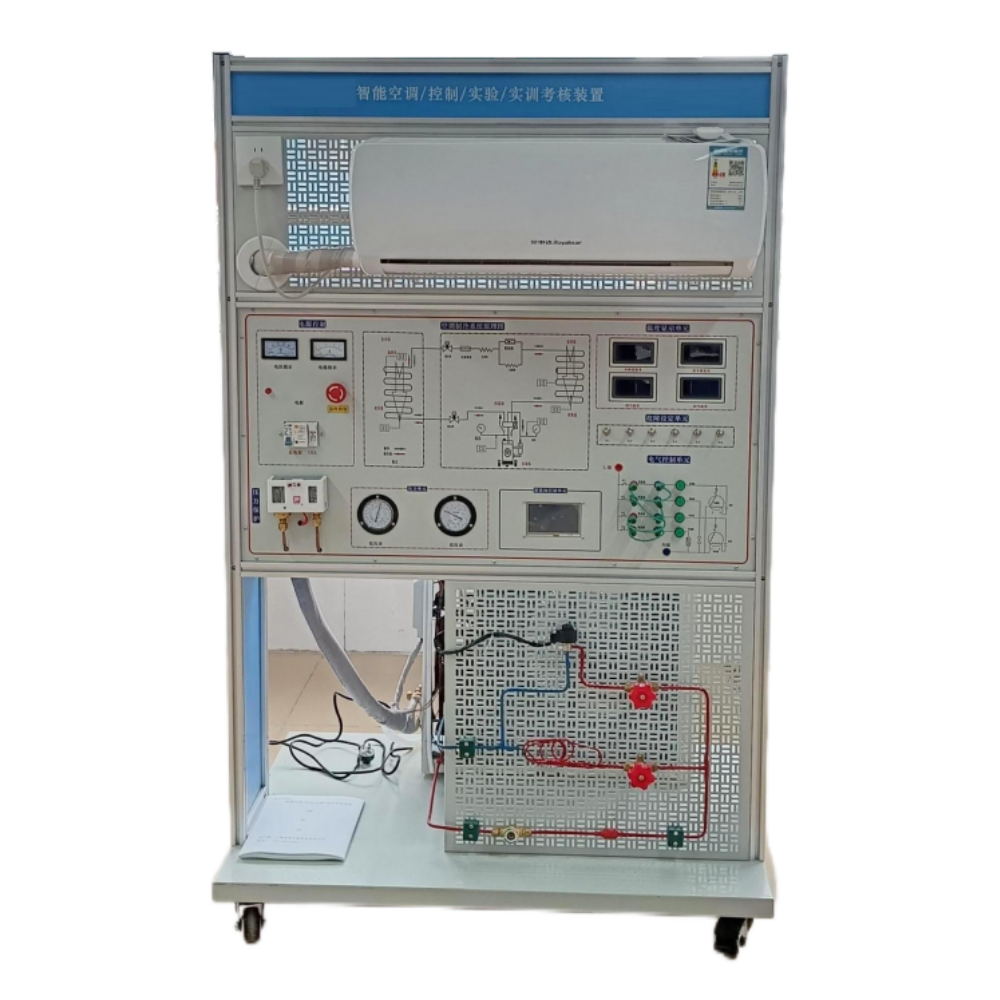
The equipment shall comprise a fully operational split-type air conditioning system mounted on a mobile training platform, including indoor and outdoor units, instrumentation, fault simulation modules, accessories, and instructional documentation.
The unit shall be complete in all respects and ready for immediate instructional use.
1.2 Purpose
The training device shall enable:
1.3 Applicable Standards
The equipment shall comply with applicable international standards, including but not limited to:
All refrigerants supplied shall comply with international environmental regulations.
2. SYSTEM DESCRIPTION
The Split Air Conditioner Training Device shall be based on a real commercial split-type air conditioner system and shall consist of:
Both indoor and outdoor units shall be mounted on a common aluminum structural training frame with heavy-duty casters.
The system shall operate in:
3. MECHANICAL CONSTRUCTION
3.1 Training Platform
3.2 Refrigeration System
3.2.1 Refrigerant
3.2.2 Outdoor Unit (Condenser Section)
Shall include:
3.2.3 Indoor Unit (Wall-Mounted Evaporator)
3.3 Refrigeration Circuit Accessories
The refrigeration system shall include:
4. ELECTRICAL SYSTEM
4.1 Power Requirements
4.2 Control Panel
The instrument control panel shall include:
All wiring shall be internally routed and clearly identified.
4.3 Temperature Measurement
Digital temperature display units shall meet:
Quantity: 4 sets.
5. FAULT SIMULATION SYSTEM
The equipment shall include:
The system shall allow simulation of common air-conditioning faults for training purposes.
6. INSTRUMENTATION AND TRAINING ACCESSORIES
The following standard accessories shall be supplied:
7. FUNCTIONAL REQUIREMENTS
The system shall allow students to perform:
8. SAFETY REQUIREMENTS
The system shall include:
All exposed rotating or live parts shall be properly guarded.