EN

Refrigerator Training System
Shipping Way: By Sea / Air / Express
Certification: CE/ ISO / GPSR / Copyrights / Patents...
OEM Service: Accept OEM Accept ODM
Customization: Logo / Size / Appearance / Material...
Technical Support: Software / Manual / Video / Technician
- Overview
- Recommended Products
MODEL:BORACS-02
1. Scope of Supply:
Provide, deliver, install, test, commission, and hand over a complete refrigerator training system, including: a training bench with a complete refrigeration circuit, an integrated data acquisition system, authorized data acquisition software, an RFID power management system, a branded desktop computer, an offline UPS, all instruments, accessories, and documentation. The system is complete, operational, and ready for immediate use in teaching.
2. Overview:
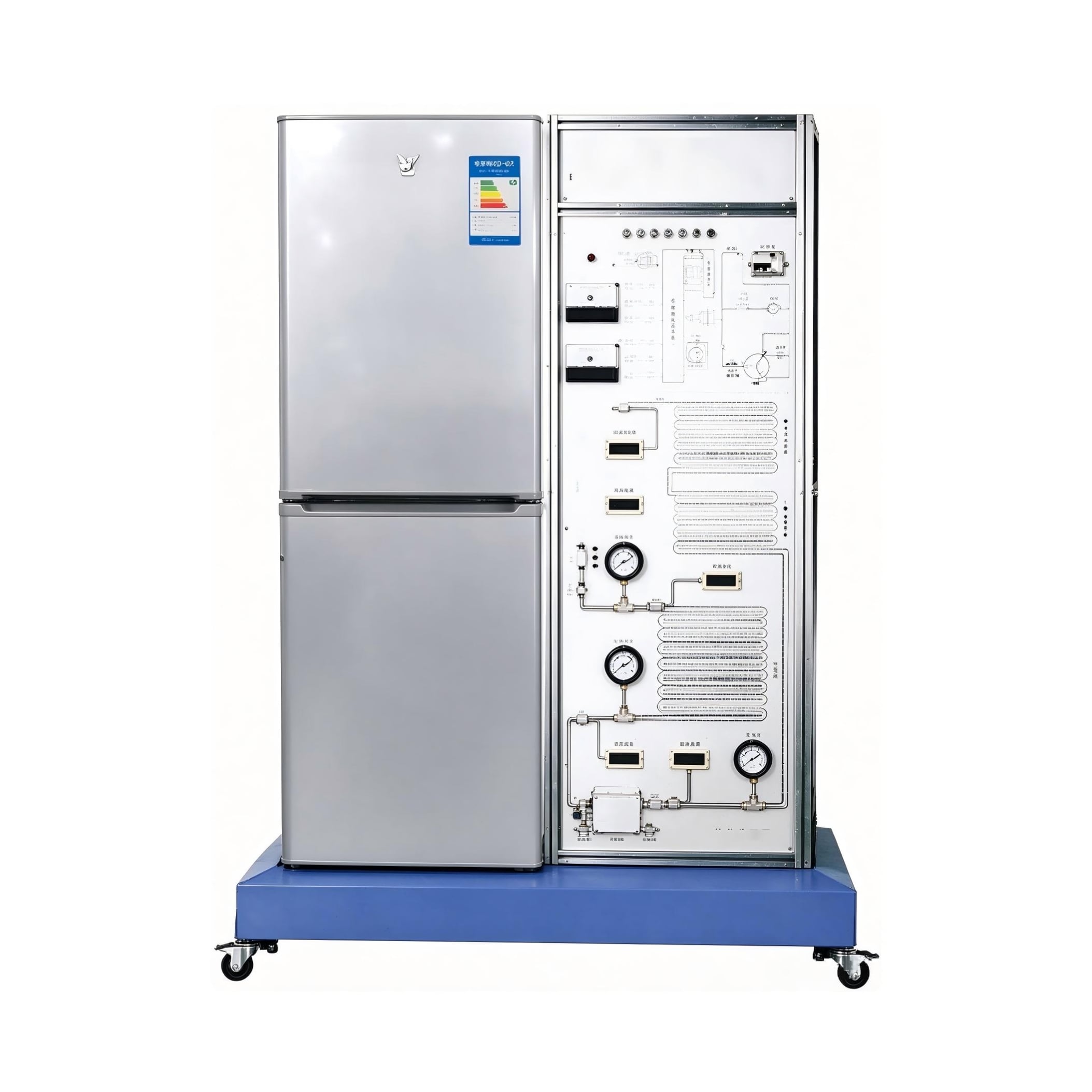
The refrigerator training system is a desktop-type teaching unit designed specifically for laboratory research in refrigeration thermodynamics and system performance analysis.
This system enables students to: observe and analyze the various stages of the refrigeration cycle; plot and interpret pressure-enthalpy (P-h) diagrams; determine superheat and subcooling; calculate the coefficient of performance (COP); compare actual cycle performance with the reverse Carnot cycle; and evaluate compressor efficiency.
The refrigerant is R134a or an equivalent environmentally friendly refrigerant.
3. Mechanical Structure:
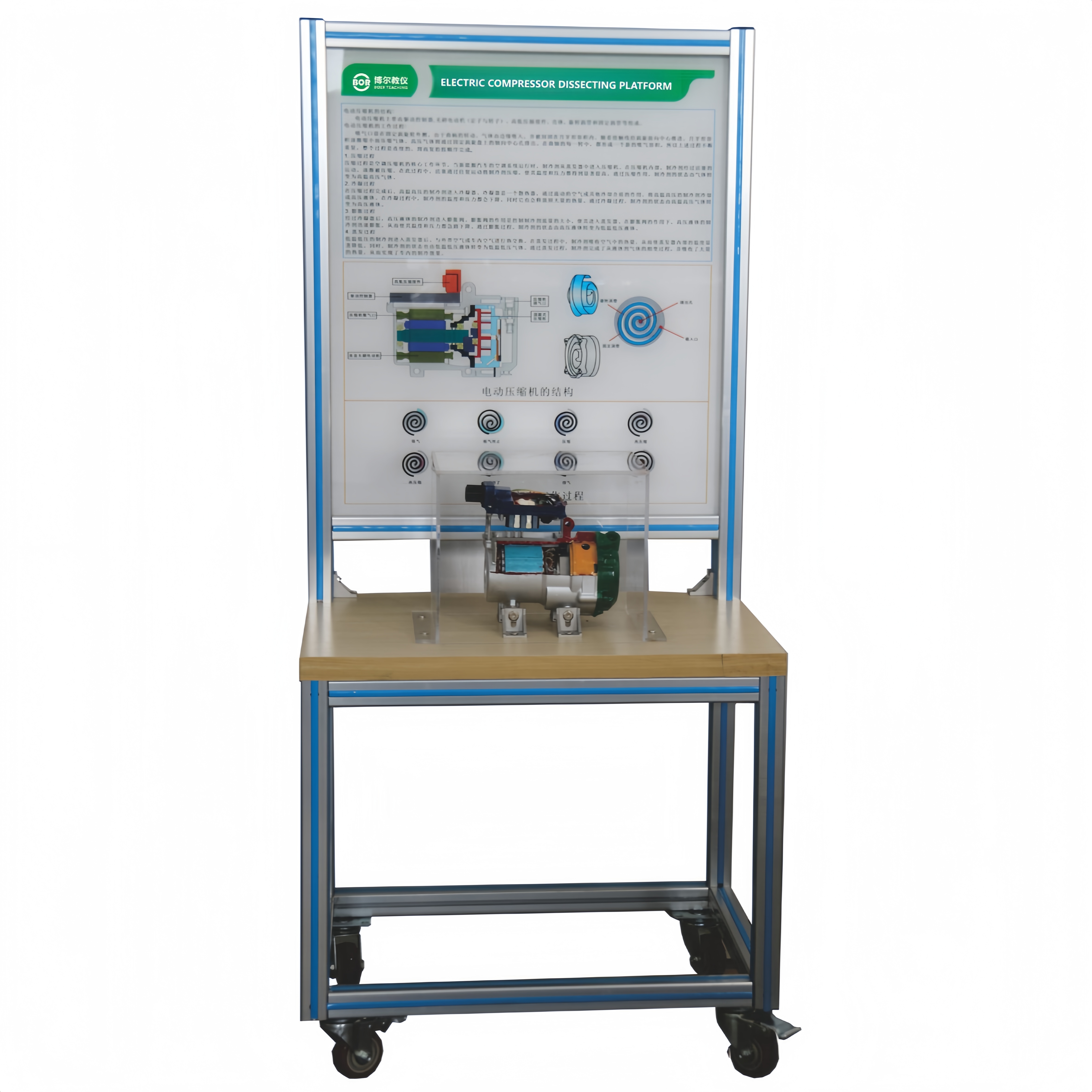
Training Bench: Movable aluminum profile structure.
Dimensions: 1200 (L) × 700 (W) × 1600 (H) mm
Mounted on four casters: two with brakes, two without brakes.
Front Demonstration Board: Silkscreened refrigeration circuit diagram, clearly labeled components, color-coded refrigerant piping (red/blue).
4. Electrical Requirements:
Power Supply: 220V ±10%, single phase, 50Hz
Rated Current: 10A
Residual Current Circuit Breaker (16A) Key Switch (self-locking)
Emergency Stop Button (self-locking) Overload Protector (5A)
Indicator Lights (at least 5) Power Monitoring Module
5. Refrigeration System Components:
This system includes, but is not limited to, the following components:
Compressor: Power: 1/8 HP; Displacement: approx. 4 cm³ ; Cooling capacity: approx. 329 watts (compliant with EN 12900)
Condenser (with water tank): Spiral copper tubing (12-14 turns); outer diameter 1/4 inch tubing; submerged in the water tank; heat exchange area approx. 0.082 square meters.
Evaporator (with water tank): Spiral copper tubing (7-9 turns); outer diameter 1/4 inch tubing; submerged in the water tank; heat exchange area approx. 0.049 square meters.
Circulation Pump: Voltage: 220V ±10%; Power: 165 watts; Adjustable (three power settings); Flow rate: approx. 80 liters/minute; Quantity: 2 pieces
Expansion Valve: Built-in balanced thermostatic expansion valve (TEV).
Filter/Dryer: 1/4 inch connection
Service and Manual Valve: Flared threaded connection. 1/4 inch pipe diameter. Sight glasses:
Installed at the liquid line, suction line, and evaporator inlet (3 pcs).
6. Instruments and Sensors:
System includes:
Low pressure gauge: -30 ~ 260 psi
High pressure gauge: -30 ~ 550 psi
Pressure transmitter: 0–2 MPa (4–20 mA output) – 2
Temperature transmitter (PT100) – 4
Digital thermometer (-40°C to +90°C) – 4
Pointer voltmeter (0–250V)
Pointer ammeter (0–5A)
LCD display for real-time measurement
Analog input module
Power monitoring module
High/low pressure controller.
Pressure and temperature should be measurable at multiple points in the refrigeration circuit.
7. Water Tanks and Heat Exchange System:
• Evaporator and condenser coils submerged in separate water tanks.
• Water tank temperature sensors provided.
• The circulation system allow circulation between water tanks during steady-state testing.
• The system allow demonstration of cooling and heat pump circulation.
8. Integrated Data Acquisition System:
The system includes a built-in multi-functional data acquisition system with the following specifications: USB connection to a computer; Real-time data acquisition; High-precision measurement capabilities; Manual and automatic data logging; Configurable sampling intervals (time-based or interval-based); Digital and analog instrument display modes; User-friendly graphical interface; Customizable layout and display.
All necessary USB cables will be provided.
9. RFID Power Management System (Mandatory):
The equipment shall include an integrated RFID-based power control system with the following functions: Operating frequency: 13.56 MHz (high frequency); Communication via RS485 (standard); LED display for showing RFID card information; Audible status prompts; LED indicators; Data verification function; Parameter configuration via software; Compliance with ISO-15693 protocol; Support for ModBus_TCP and ModBus_RTU.
The RFID system will control power activation via card authentication.
11. Learning Functions:
The system supports the following experimental exercises:
using pressure-enthalpy diagrams; determining superheat and subcooling; refrigeration energy balance; calculating the coefficient of performance (COP); determining isentropic efficiency and volumetric efficiency; the effect of heat source and cold source temperatures on COP; and comparison between actual and reverse Carnot cycles.
Manuals: The machine comes with an English user manual, training/experiment manual, circuit schematic diagram, refrigeration circuit diagram, maintenance manual, spare parts list, RFID system documents and software (electronic version).