EN
EN

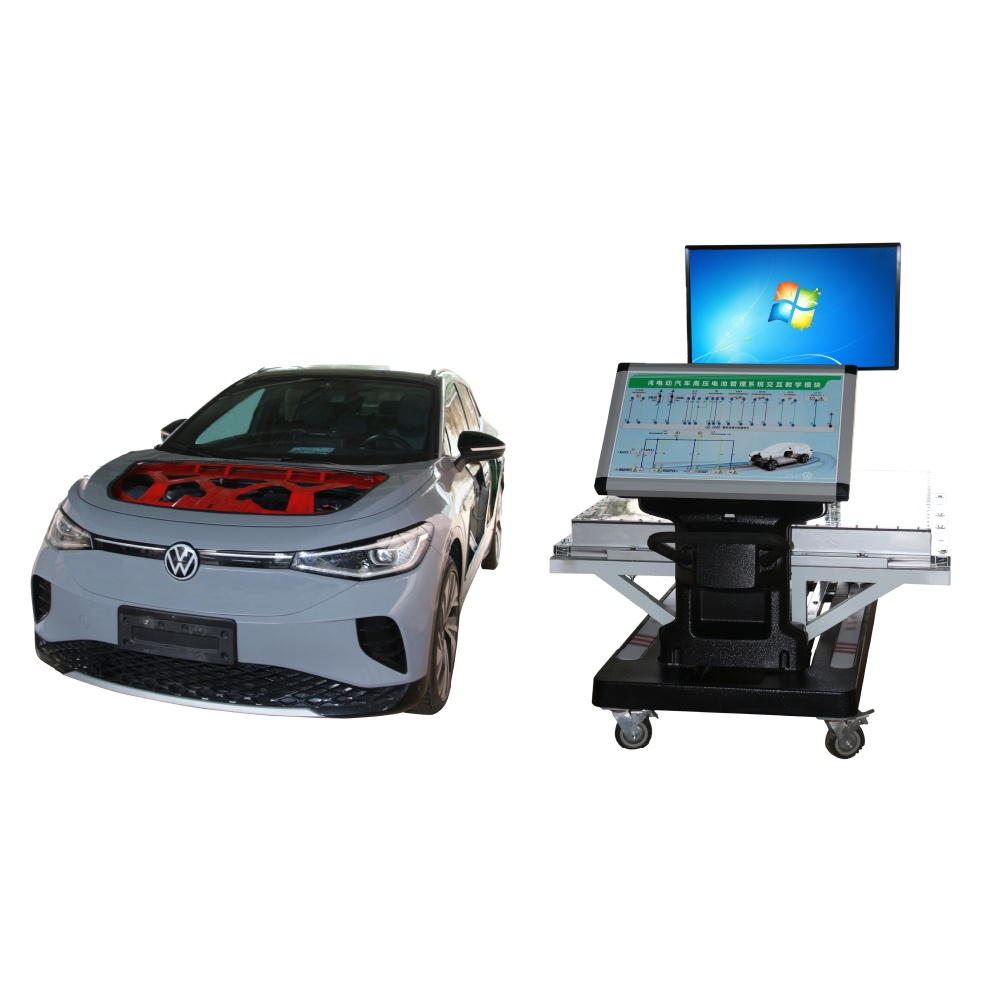
Interactive teaching module for high-voltage battery management in pure electric vehicles
Minimum Order : 1 Set
Warranty: 2 years
Delivery: EXW Guangzhou
Shipping Way: By Sea / Air / Express
Certification: ISO / GPSR / Copyrights / Patents...
OEM Service: Accept OEM Accept ODM
Customization: Logo / Size / Appearance / Material...
Technical Support: Software / Manual / Video / Technician
- Overview
- Recommended Products
Product Overview:
This training uses original factory-installed pure electric vehicle power battery packs (including BMS management system), installing genuine original vehicle components and retaining original vehicle control functions, as well as original high-voltage distribution boxes and on-board chargers.
It realistically demonstrates the connection and control relationships, installation locations, and operating conditions between core components of lithium iron phosphate power battery packs, and highlights high-voltage system safety precautions, cultivating students' ability to analyze and handle faults in lithium iron phosphate high-voltage batteries. Suitable for teaching and maintenance training in new energy pure electric vehicle power battery management courses in various types of educational institutions.
Features:
1. All major components are installed on a training platform, allowing for easy disassembly and assembly after power failure. The training lines retain the original vehicle's electrical connection methods and backup power, enabling students to master the disassembly and assembly of high-voltage system components and key safety protection points.
2. It adopts the original vehicle's battery management system, consisting of a battery management controller, a battery information collector, and power battery sampling lines.
3. The battery management controller retains original vehicle functions, such as charge/discharge management, contactor control, alarms and protection, power control, battery abnormal status monitoring, SOC/SOH calculation, self-testing, and communication functions.
4. The battery information acquisition unit retains original vehicle functions, such as battery voltage sampling, temperature sampling, battery equalization, and sampling line anomaly detection.
5. The power battery sampling line retains original vehicle functions, such as connecting the battery management controller and the battery information acquisition unit to enable communication and information exchange between them.
6. The battery management system (BMS) retains original vehicle functions, such as active equalization, switch control protection (cell disconnection, short circuit, overvoltage, undervoltage, overcurrent, overtemperature), CAN communication with the charger, controlling the vehicle and charger operation through the BMS, and estimating SOC (State of Charge).
7. The original vehicle instrument panel is installed, allowing observation of various parameters during the charging and discharging process. It retains the original instrument panel functions, the control logic of the power battery pack's charging and discharging process, and the parameter changes of major components. The training platform provides a high-voltage power supply and original vehicle connection cables, retaining the original vehicle connection method.
8. Equipped with a 12V auxiliary power grounding mechanical switch, it can quickly disconnect the high and low voltage power supply of the system. The power high-voltage distribution box cover is made of 5mm transparent acrylic glass, allowing observation and understanding of the control principle and internal control components.
9. A teaching board is provided, fully displaying the power battery pack, charging and discharging working principle diagrams, and low-voltage control circuit installation test terminals, allowing direct testing of the electrical signals of system circuit components on the panel, such as resistance, voltage, current, frequency, and waveform signals.
10. The panel is made of impact-resistant, stain-resistant, fire-resistant, and moisture-proof high-grade molybdenum plastic board, with a special process for primer coating. The panel is printed with color circuit diagrams that will never fade. The equipment consists of a platform and a teaching board. The platform is placed horizontally and original vehicle parts are installed. The training platform is equipped with four self-locking casters at the bottom.
11. The panel part is made of 1.5mm cold-rolled steel sheet, with an aesthetically pleasing appearance. The base frame is constructed of welded steel with a powder-coated finish. It features self-locking casters and a 30cm tabletop on the teaching board base for placing materials and lightweight testing instruments.
12. Equipped with an intelligent fault setting and dedicated system, fault points are primarily located in the low-voltage control circuit to ensure the safety of the high-voltage system and to train practical vehicle fault handling capabilities. The bench is fitted with an insulated floor (standard insulating and voltage-resistant flooring). A training manual is included, covering system operating principles, training subjects, fault setting and clearing, and other key points.
Technical Specifications:
Vehicle Dimensions: 4612 × 1852 × 1640 mm (Length × Width × Height)
Bench Dimensions: 1740 × 600 × 1700 mm (Length × Width × Height)
Power Supply: Lithium iron phosphate battery pack
Operating Temperature: -20℃ ~ +60℃