EN
EN

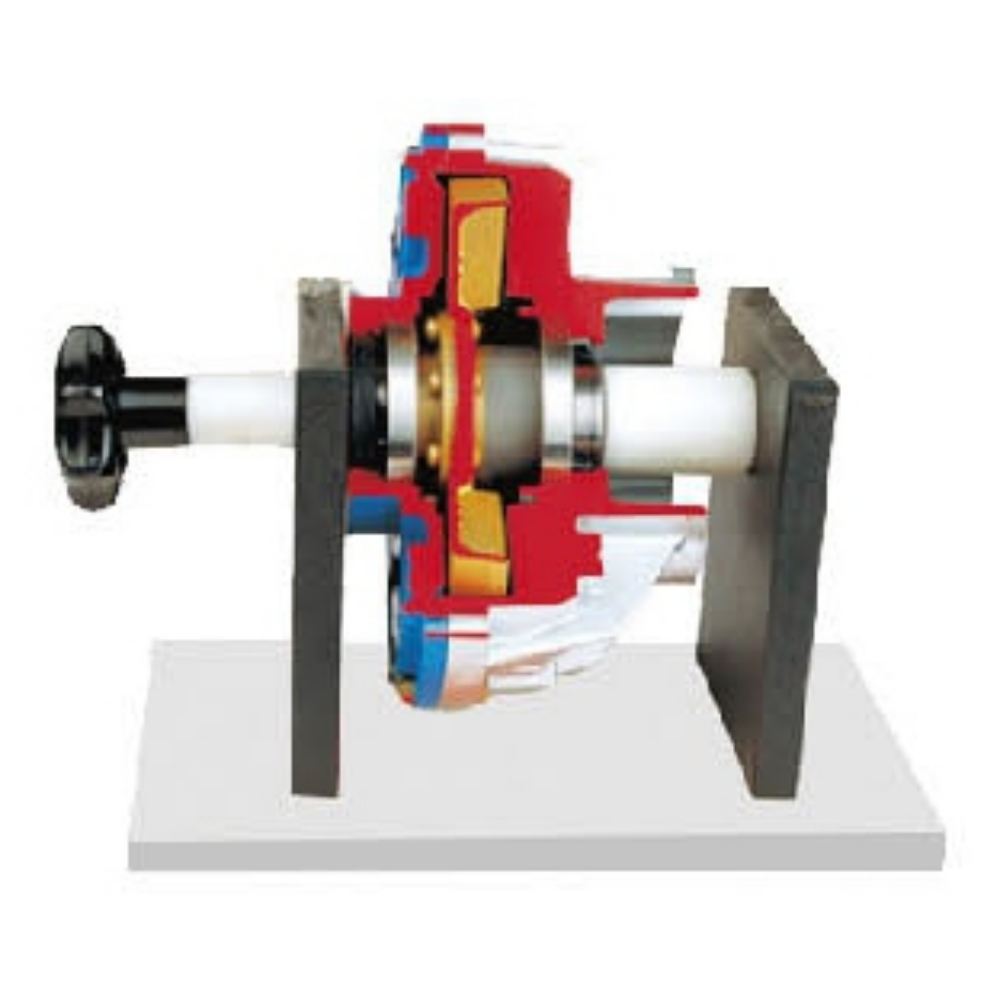
Hydraulic coupler anatomical model
Delivery: EXW Guangzhou
Shipping Way: By Sea / Air / Express
Certification: CE/ ISO / GPSR / Copyrights / Patents...
OEM Service: Accept OEM Accept ODM
Customization: Logo / Size / Appearance / Material...
Technical Support: Software / Manual / Video / Technician
- Overview
- Recommended Products
Product Overview:
The hydraulic coupling dissection model is an immersive teaching and training device designed specifically for vocational schools and corporate training centers in the automotive, engineering machinery, and mining machinery industries. Based on a real hydraulic coupling (or a precisely replicated industrial-grade model), the model undergoes professional dissection and reinforcement, visually presenting the structural relationships and spatial arrangement of core components such as the pump impeller, turbine, housing, input/output shafts, sealing system, and oil circulation chamber. It also retains the manually rotatable transmission link. Combined with accompanying teaching materials, it achieves a complete teaching chain from static structural understanding to dynamic working principles and maintenance procedures, serving as a highly efficient training medium to replace purely theoretical lectures and on-site observation of large equipment.
Features:
Structural Understanding Function: Clearly presents all core components such as the housing, pump impeller, turbine, working chamber, and input/output shaft; the cut surfaces are professionally colored to distinguish them, allowing unobstructed observation of the 3-4mm inter-impeller clearance and annular oil flow channel; it can be used with a manual to label the names of each part and their assembly relationships.
Demonstration Function: Simulates the power transmission process of a pump impeller driving oil to generate centrifugal force, impacting the turbine and forming a spiral circulation flow through manual cranking or low-speed electric drive; provides an intuitive understanding of the flexible transmission principle of "no rigid contact, torque transmission through liquid momentum"; demonstrates slip rate, overload protection, and smooth start-up characteristics.
Practical Training Function: Retains original fasteners and disassembly/reassembly processes, supporting standardized maintenance training including full disassembly, cleaning, testing, and assembly; simulates troubleshooting and diagnosis of common faults such as oil leakage and impeller wear; some sections include transparent oil chambers/circuit demonstrations showcasing oil circulation and pressure changes.
Teaching Extension Function: Adaptable to classroom demonstrations, group training, and skills assessments; can be linked with motor/gearbox benches to construct complete transmission system teaching scenarios; provides accompanying courseware and disassembly/reassembly manuals, combining theory and practice, and highlighting structural and technological characteristics.
Physical Dissection + Professional Machining: Utilizing industrial-grade hydraulic couplings, precision CNC cutting ensures smooth, burr-free cut surfaces; key components are reinforced to balance clarity and structural strength.
Stable Installation and Safety Design: Equipped with a welded steel plate base/stand, suitable for tabletop, wall mounting, or mobile installation; blunted edges prevent scratches; electrically driven models feature overload protection and emergency stop switches.
Durability and Visualization: Rust-proof surface coating; color-coded cut surfaces (e.g., blue for the pump impeller, red for the turbine); some models include a transparent observation window for adding colored demonstration oil, allowing dynamic observation of fluid flow direction.
High Versatility: Suitable for teaching hydraulic couplings in various fields such as automotive, construction machinery, shipbuilding, and mining machinery; supports customized dissection schemes for different specifications and models.
Practical Training Projects:
I. Structural Recognition Training:
Identify the main components of the hydraulic coupling, including the housing, pump impeller, turbine, input shaft, output shaft, and working chamber.
Refer to the cut surfaces to indicate the shape, installation direction, and relative position of the pump impeller and turbine blades.
Understand the basic structural characteristics of a hydraulic coupling that transmits power without rigid connections.
Complete component labeling and structural diagram drawing.
II. Dynamic Demonstration of Working Principle Training:
Manually/electrically drive the input shaft and observe the pump impeller rotation driving the oil circulation.
III. Disassembly and Assembly Training:
Disassemble the hydraulic coupling according to the standard procedures.
Inspect the wear, seals, and clearances of each component.
Reassemble, adjust, and tighten according to process requirements.
Train on the use of disassembly and assembly tools, torque control, and proper placement of parts.
IV. Key Parameter and Clearance Measurement Training:
Measure the clearance between the pump impeller and turbine.
Measure the coaxiality and axial movement of the input and output shafts.
Record the data and determine if it meets the standard range.
V. Fault Phenomenon Simulation and Analysis Training
Simulated Insufficient Oil: Weakened power transmission, slippage.
Simulated Blade Damage: Decreased transmission efficiency, increased vibration.
Simulated Bearing Wear: Abnormal noise, axial runout.
Determine the cause of the fault based on the phenomena and write an analysis report.
VI. Training on Linkage with Transmission System (Can be equipped with a test bench)
Connect the hydraulic coupling to the motor, gearbox, and load device.
Observe the power transmission characteristics during start-up, acceleration, and overload.
Compare the differences between rigid transmission and hydraulic transmission.
VII. Assessment Training
Timed structural identification and verbal explanation of working principles.
Timed standardized disassembly and assembly.
Write out the diagnostic approach based on the fault phenomena.