EN
EN

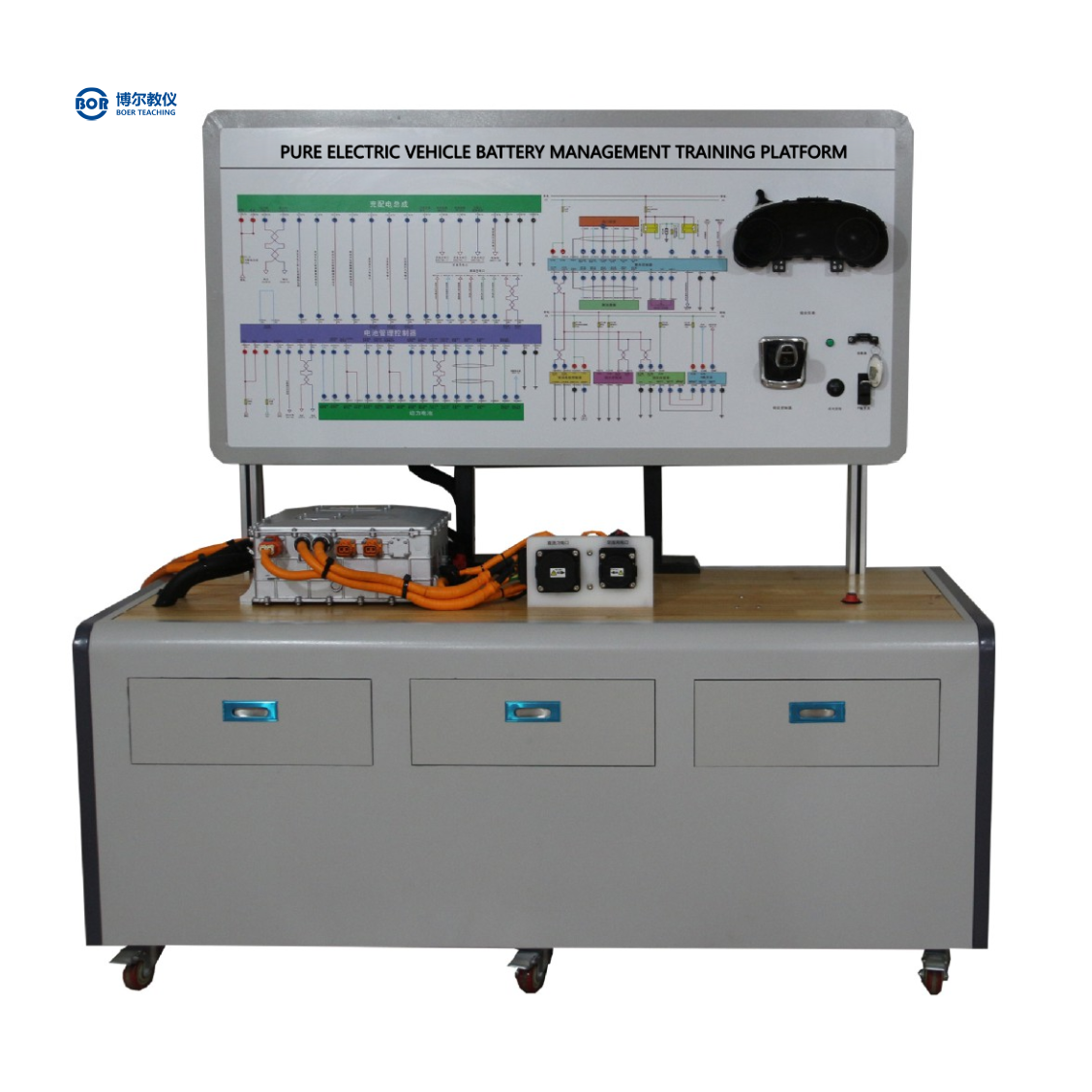
Pure Electric Vehicle Battery Management Training Platform
Minimum Order : 1 Set
Warranty: 2 years
Delivery: EXW Guangzhou
Shipping Way: By Sea / Air / Express
Certification: ISO / GPSR / Copyrights / Patents...
OEM Service: Accept OEM Accept ODM
Customization: Logo / Size / Appearance / Material...
Technical Support: Software / Manual / Video / Technician
- Overview
- Recommended Products
Product Overview:
This product utilizes a lithium iron phosphate (LFP) battery pack for new energy vehicles, featuring 24 individual 3.2V 20AH cells in series, and an integrated BMS (Battery Management System) with a CAN bus, including passive balancing functionality.
It realistically demonstrates the connection and control relationships, installation locations, and operating parameters of the core components of the LFP battery pack, as well as high-voltage system safety precautions. It also cultivates students' ability to analyze and handle faults in the LFP battery pack (BMS).
Suitable for understanding and verifying the power battery parameters of electric vehicles, performing real-time monitoring, fault diagnosis, SOC estimation, short-circuit protection, insulation detection, charge/discharge control, and balancing functions. It interacts with the on-board charger via CAN bus, ensuring the efficient, reliable, and safe operation of electric vehicles through BMS teaching and training experiments.
Features:
1. A realistic and operable new energy power battery charging and discharging assembly, fully demonstrating the structural composition and logical control relationships of each major component. All major components are mounted on a training platform with electrical connections identical to those in a real vehicle, allowing for easy disassembly and reassembly. This allows students to master the key points of high-voltage system component disassembly and reassembly and the safety protection during the process.
2. The BMS (Battery Management System) features passive balancing and switch control protection (cell disconnection, short circuit, overvoltage, undervoltage, overcurrent, and overtemperature). It communicates with the on-board charger via CAN and controls the charger's operation, estimating SOC (State of Charge).
3. It acquires cell voltage, total voltage, current, and temperature data. It has comprehensive fault alarm functions, including voltage, current, and temperature fault alarms.
4. It features SOC estimation, charge/discharge control, and passive balancing management. The system switches use passive mechanical contacts.
5. A 7-inch touchscreen display is mounted on the panel, allowing observation of various parameters during the charge/discharge process, and understanding of the control logic and parameter changes of key components. It is equipped with compatible BMS host computer calibration software. The training platform is equipped with a discharge module to simulate the energy consumption process of a vehicle. The discharge current can be selected. The power battery pack is equipped with a switch for mechanical maintenance of new energy vehicles.
Technical Specifications:
Dimensions: 1500 × 700 × 1700 mm (L*W*H)
Power Supply:
12V 40A DC (Switching Power Supply) / 220V AC
Operating Temperature: -20° ~ 60°